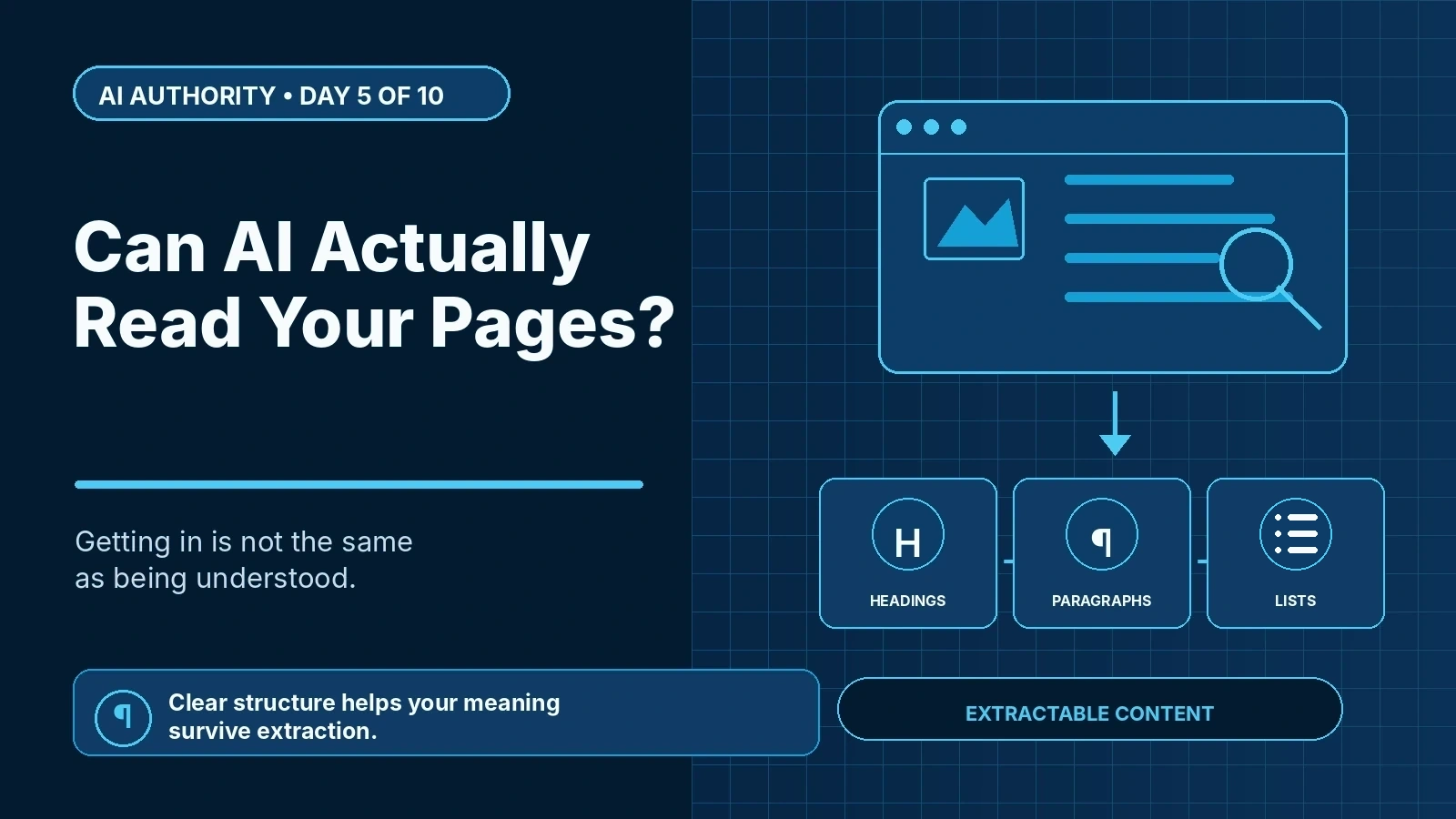
Day 4 was about letting AI reach your website. Day 5 asks what happens after it gets in: can it understand the page well enough to use the answer? A beautiful real estate page can still be confusing once the design is stripped away.
Clear structure helps meaning survive extraction
Retrieval systems may divide a webpage into smaller passages before matching it to a question. The usefulness of those passages depends on semantic HTML, a logical heading hierarchy and paragraphs that carry their own context. Important information can lose meaning when it exists only inside images, appears only after an interaction, or depends on the surrounding visual layout. There is no universal ideal paragraph length; the practical goal is to make each important answer clear, direct and understandable on its own.
In Plain English
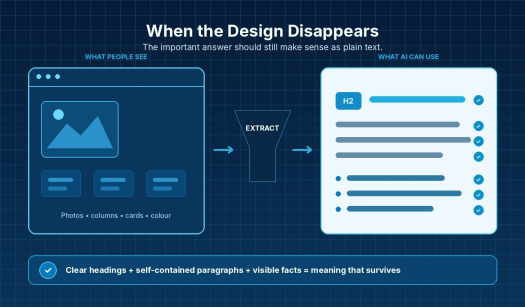
AI does not read a webpage exactly as a person does. A visitor sees colours, columns, photographs, icons and visual emphasis. AI may work mainly with the headings, paragraphs, lists and tables it can extract.
It may then evaluate a smaller section of the page on its own. That means a paragraph about a neighbourhood, market trend or real estate service should still make sense without the paragraph above it or the photograph beside it.
What This Changes in Practice
Answer first, context second
Lead with the direct answer, then explain. Do not make buyers or sellers wait through several paragraphs to reach the point.
Use real headings
Use headings that clearly describe the subject or question. Text that only looks large is not automatically a heading to a machine.
Keep paragraphs self-contained
Name the subject inside the paragraph. A paragraph beginning with “This means that” can become unclear when separated from the text above it.
Get important facts out of images
Repeat market statistics, service areas and key advice in visible text. Do not leave the only explanation inside a graphic, slider or video.
Use lists and tables for comparisons
Steps, features and comparisons are easier for people to scan, and their structure is more likely to remain clear after extraction.
Try the Plain-Text Test
Copy the main content from one important page and paste it into a plain-text file. Ignore the menu, photographs and design. Then read it again.
If the page stops making sense without the visuals, that is roughly the problem AI may encounter. Try this with a neighbourhood page, market update, buyer guide or seller resource.
What happens during extraction?
This section is optional. The main lesson above is all most real estate agents need.
- Document structure matters. Headings, paragraphs, lists and tables give an HTML page useful boundaries and context.
- Smaller passages still need enough context. Microsoft notes that chunks which are too small can perform poorly because the surrounding meaning is lost.
- There is no magic word count. Google says pages do not need to be broken into tiny pieces for generative AI search and that there is no universal ideal page length.
- Core information should not require an action to appear. Important text that depends on a click, scroll, tab or script may not be available consistently to every crawler or retrieval system.
Official references: Google generative AI guidance · Microsoft RAG chunking guidance · W3C heading guidance · Google lazy-loading guidance
The Takeaway
Good structure is not about writing for robots. It makes your content easier for buyers, sellers, search engines and AI tools to understand.
Schema: The Label on the Outside of the Box
Stop making AI guess who you are.