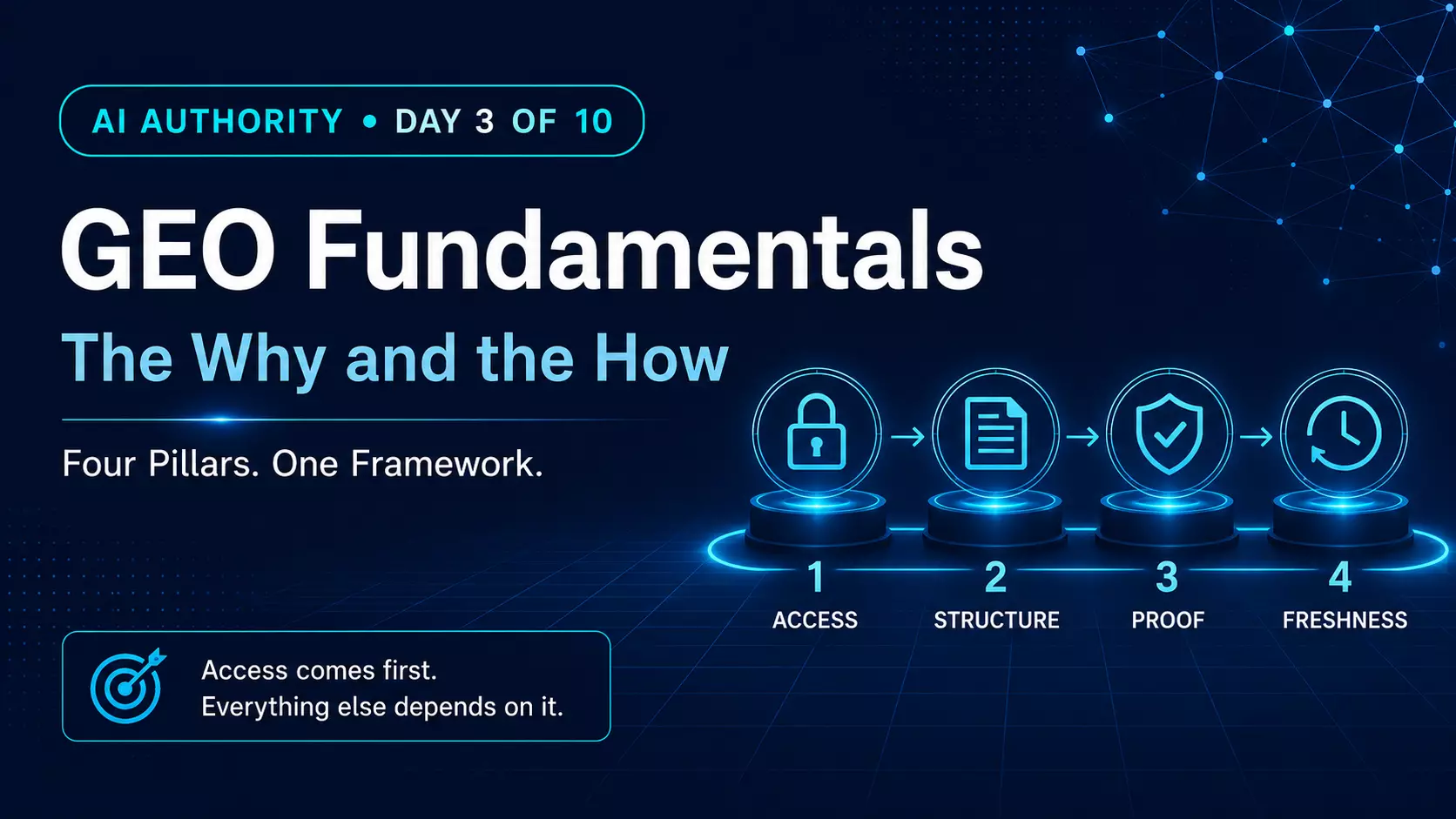
GEO is not one trick or one piece of code. It is a sequence of four conditions that must work together: Access, Structure, Proof, and Freshness. Day 3 introduces the complete framework.
Four dependent conditions
GEO performance can be understood as four dependent conditions. First, crawl access: a search or retrieval agent must be permitted to fetch the resource. Second, extractability: the useful content must survive parsing as clear, self-contained information. Third, corroboration: important entity details and claims should be consistent with credible sources elsewhere. Fourth, recency: time-sensitive information should be meaningfully current and supported by visible, verifiable dates. A failure early in the sequence limits everything that follows.
Why the order matters
For many customers, an AI assistant is becoming an early stop in the buying process. People ask who to hire, what to buy, where to go, and which option best fits a specific situation. The first answer can shape the entire consideration set.
That creates a simple challenge. Your content must first be reachable, then understandable, then believable, and finally current enough for the question being asked.

The four pillars, one by one
Access
Can AI and search systems reach the page?
Your best answer is useless when a crawler receives a block, an error, a login screen, or an empty response. Access is the first gate.
- Important pages should load publicly with a normal successful response.
- Robots rules, noindex directives, CDN settings, and firewalls should match your actual intent.
- Do not assume every automated visitor is performing the same job. Search retrieval and model training can be governed separately.
Structure
Once they arrive, can they cleanly understand the answer?
Useful information should be visible, organized, and easy to separate from navigation, widgets, and decorative elements. Clear structure helps people and machines at the same time.
- Put the main answer in readable page text, not only inside an image, video, slider, or downloadable file.
- Use descriptive headings, focused paragraphs, and logical page sections.
- Use accurate structured data where appropriate, and keep it aligned with what visitors can actually see.
Proof
Do credible sources support what your website says?
A business can claim almost anything about itself. Confidence grows when key facts and areas of expertise are also supported by independent, credible sources.
- Keep your business name, location, phone number, leadership, service area, and specialties consistent across the web.
- Use specific evidence such as documented experience, original examples, professional profiles, recognized memberships, and attributable reviews.
- Build real corroboration. Manufactured mentions and low-quality directory spam are not a durable substitute for proof.
Freshness
Is the information current, and can that be verified?
Freshness matters most when the answer can change, such as pricing, market conditions, personnel, availability, regulations, and service details.
- Show clear published or last-updated dates when they help the reader judge timeliness.
- Update the substance of a page, not just the date displayed at the top.
- Correct stale facts and retire outdated claims rather than allowing conflicting versions to remain online.
What official guidance confirms
The terminology and implementation details vary by platform, but the foundational pattern is visible in current platform guidance.
Access and structure: Google's guidance for generative AI features says visibility still depends on public, crawlable content, Search eligibility, clear technical structure, and helpful information. OpenAI's publisher guidance says sites that want content included in ChatGPT search summaries and snippets should not block OAI-SearchBot.
Proof and freshness:
Google says its generative AI features can reflect
what is being said across the web, but warns that
seeking inauthentic mentions is not a useful shortcut.
For date signals,
Google recommends prominent user-visible publication or last-updated dates,
while
its sitemap guidance
says the lastmod value should reflect the
last significant update and remain verifiably
accurate. These are not guarantees of inclusion, but
they reinforce the need for verifiable, well-maintained
information.
A quick four-question audit
Before publishing more content, test the foundation you already have.
Ask these questions in order:
- Access: Can an unauthenticated visitor and the crawlers you intend to allow receive the complete page?
- Structure: Can someone identify the page's main answer, supporting facts, and next step without decoding a complicated layout?
- Proof: Are the important facts on the page consistent with reputable profiles and independent sources?
- Freshness: Is time-sensitive information accurate today, with an honest date and a meaningful update history?
Most weak GEO programs do not fail because they need another fifty blog posts. They fail because good content is blocked, buried, contradicted, or left to age without maintenance.
Are You Accidentally Blocking AI From Your Site?
This one catches almost everyone.