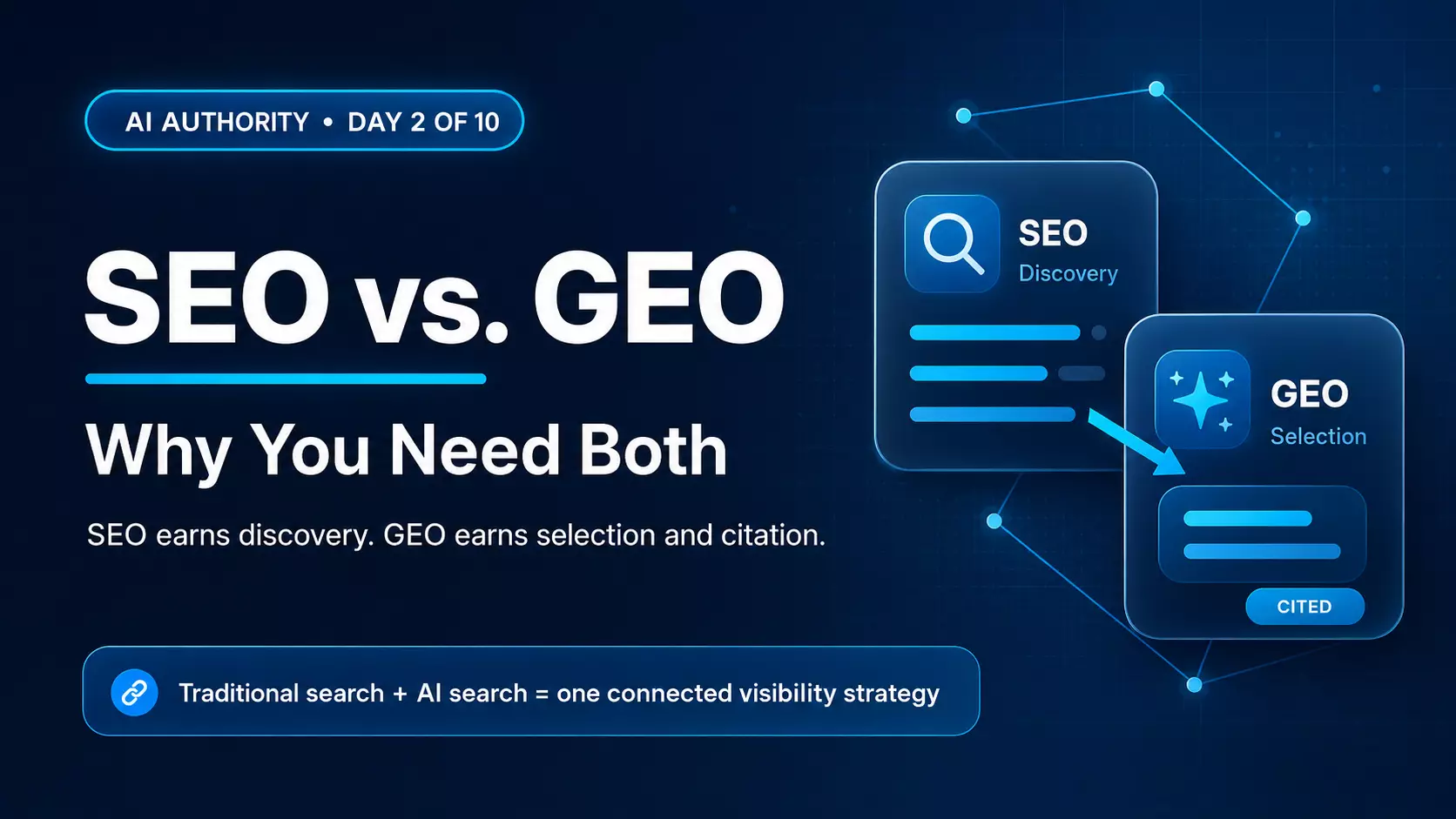
Traditional search and AI search are not competing strategies. One helps your content get discovered. The other helps it get selected and cited. Day 2 explains why one feeds the other.
How SEO and GEO connect
AI answer engines do not all maintain fully independent discovery systems. Many rely on existing web indexes, conventional crawl and ranking signals, or live search services to assemble a candidate set. They then apply passage selection, relevance scoring, and synthesis on top of those results. SEO largely governs whether your pages can be discovered, indexed, and considered. GEO improves the likelihood that a specific passage is clear, credible, and useful enough to survive selection and be cited.
In Plain English
Think of it as a two-stage audition.
SEO
SEO gets you into the room.
If your pages are not indexed, not linked to, and not considered relevant, the AI may never see them as an option.
GEO
GEO helps you get the part.
Once your page is in the running, the model looks for a passage that is clear, specific, current, and trustworthy enough to use.

Why “SEO is dead” is the wrong conclusion
This is why the “SEO is dead” headlines are wrong. Strong SEO fundamentals are still the entry ticket. GEO is what you do with the ticket.
Google’s current guidance says its generative AI search features are rooted in core Search ranking and quality systems and retrieve content from the Search index. Microsoft also documents that Copilot can send generated queries to Bing to ground responses in web information. The mechanics vary by platform, but the practical lesson is consistent: discovery still matters.
You should not tear down the search work you already have. You are adding a new layer on top of it, not replacing it.
What should you keep, and what should you add?
Keep strengthening SEO
- Make important pages crawlable and indexable.
- Build useful pages around real customer needs.
- Maintain internal links, mobile usability, and technical health.
- Earn relevant authority and links over time.
Add the GEO layer
- Lead with direct, self-contained answers.
- Use clear headings and extractable page structure.
- Make claims specific, current, and easy to verify.
- Build consistent identity and corroboration across the web.
A smaller stream can still be valuable
AI referral traffic is still much smaller than traditional search traffic for most businesses. But it can be high-intent traffic because the visitor may arrive after an AI assistant has already helped define the problem, compare options, and narrow the field.
Small stream, potentially high quality. Worth owning early, while many competitors are still arguing about whether it is real.
GEO fundamentals: the why and the how
Four pillars, one framework.