


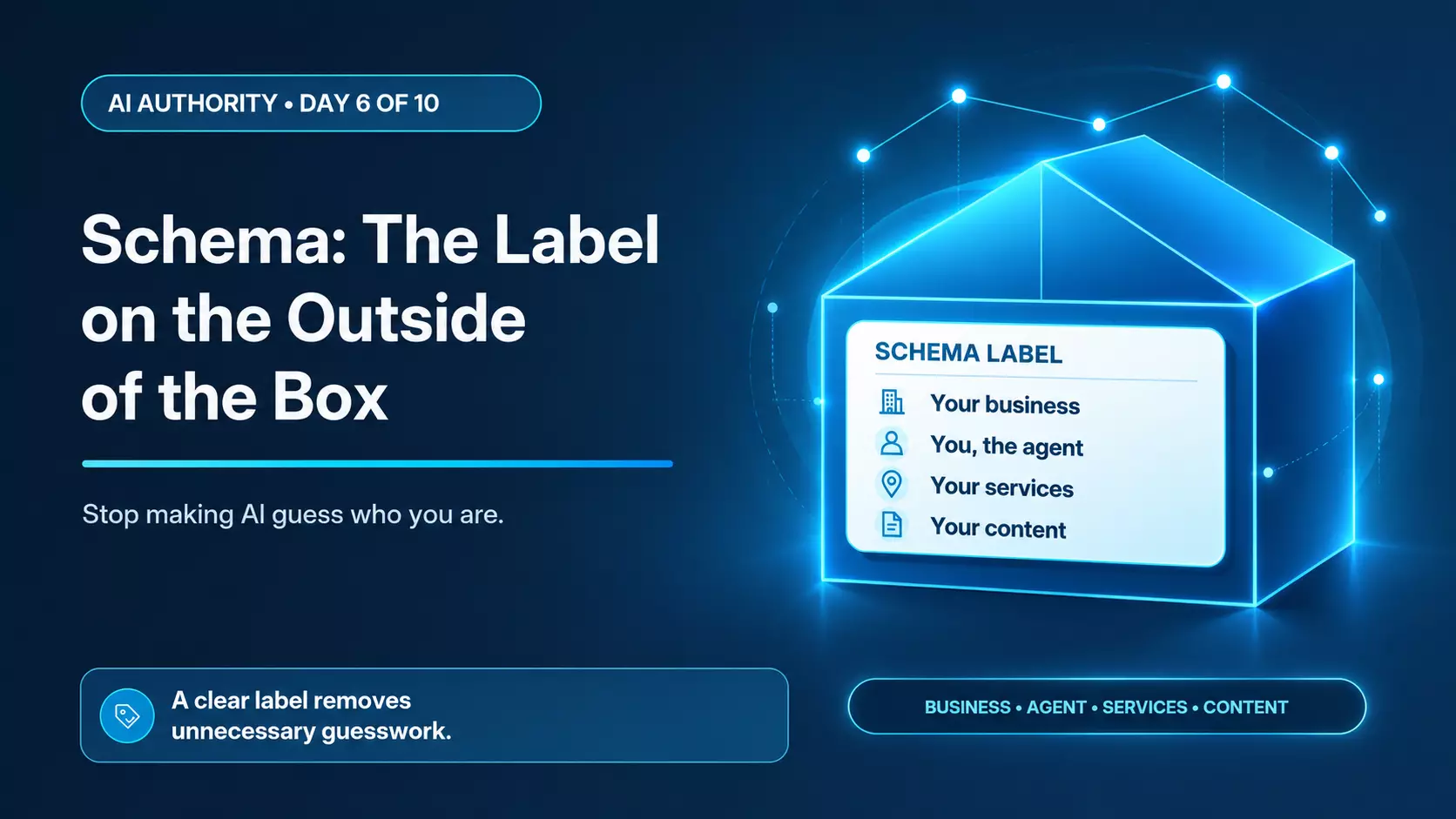
Day 5 was about making your pages readable. Day 6 asks the next question: can machines clearly identify who and what the page is about? Schema is an invisible label that connects your real estate business, people, services and content.
Structured data gives machines an explicit description
Structured data, often expressed as JSON-LD using the Schema.org vocabulary, provides a machine-readable description of the people, businesses and content on a page. Useful types for a real estate website may include RealEstateAgent or Organization for the business, Person for the agent or author, plus WebSite, WebPage, Article and Service. Stable @id references can connect them, while sameAs can point to verified profiles. This does not guarantee a ranking or citation; it simply reduces ambiguity.
In Plain English
Think about a box in a warehouse. The contents may be perfectly organized, but without a label, the person receiving it has to open it and decide what it probably is. Schema is the label on the outside of the box.
It is a small block of code that sits invisibly on a page and states the facts plainly: this is the business, this is the agent, this is what they do, this is where they work, and this person wrote the article.
A visitor can connect your logo, agent biography, service pages and market updates almost instantly. A machine may need help determining whether those details all refer to the same real estate business and the same people. Clear labels reduce the need to guess.

The Labels Most Real Estate Websites Need
Most real estate websites do not need every available schema type. The useful starting points are straightforward.
The business or agent
Identifies the brokerage, team or real estate business, including its name, website, logo, contact details and service area.
What you actually offer
Labels real services described on the page, such as buying, selling, relocation or home-value assistance.
Your market updates and guides
Identifies the article, its author, publication date and updated date.
Genuine FAQs
Connects real questions with the answers that are visibly provided on the page.
Two Details Matter Most
Consistency
The business name, phone number, location or service area, agent relationship and dates in the markup should agree with the visible page and important profiles. Conflicting facts add uncertainty instead of removing it.
Connection
The business, agent, services, articles and verified profiles should be connected rather than described as unrelated items. That helps machines recognize one consistent identity across the website.
What sits inside the invisible label?
This section is optional. The main lesson above is all most real estate agents need.
- JSON-LD is a common format. Google recommends it when a website's setup allows it.
- Use the most specific suitable type. Schema.org includes
RealEstateAgentas a type of local business, while an individual agent or author can be described as aPerson. @idandsameAsserve different purposes. A stable@idhelps connect items within the site's markup.sameAsshould point only to a page that clearly identifies the same person or business.- The markup must reflect the visible page. Hidden, outdated or misleading claims should not be added to schema.
- Validation checks the code, not the promise. Correct structured data can improve clarity and eligibility for some search features, but it does not guarantee rankings, rich results, AI mentions or citations.
Official references: Google's structured data introduction · Google's structured data guidelines · Google's LocalBusiness guidance · Schema.org RealEstateAgent · Schema.org sameAs · Structured data testing tools
The Takeaway
Schema is not a ranking trick and it is not a substitute for useful content. It is a translation layer between how you describe your real estate business and how machines catalogue it.
Why AI Trusts Some Businesses More Than Others
You cannot claim authority. It gets corroborated.


Leave A Comment