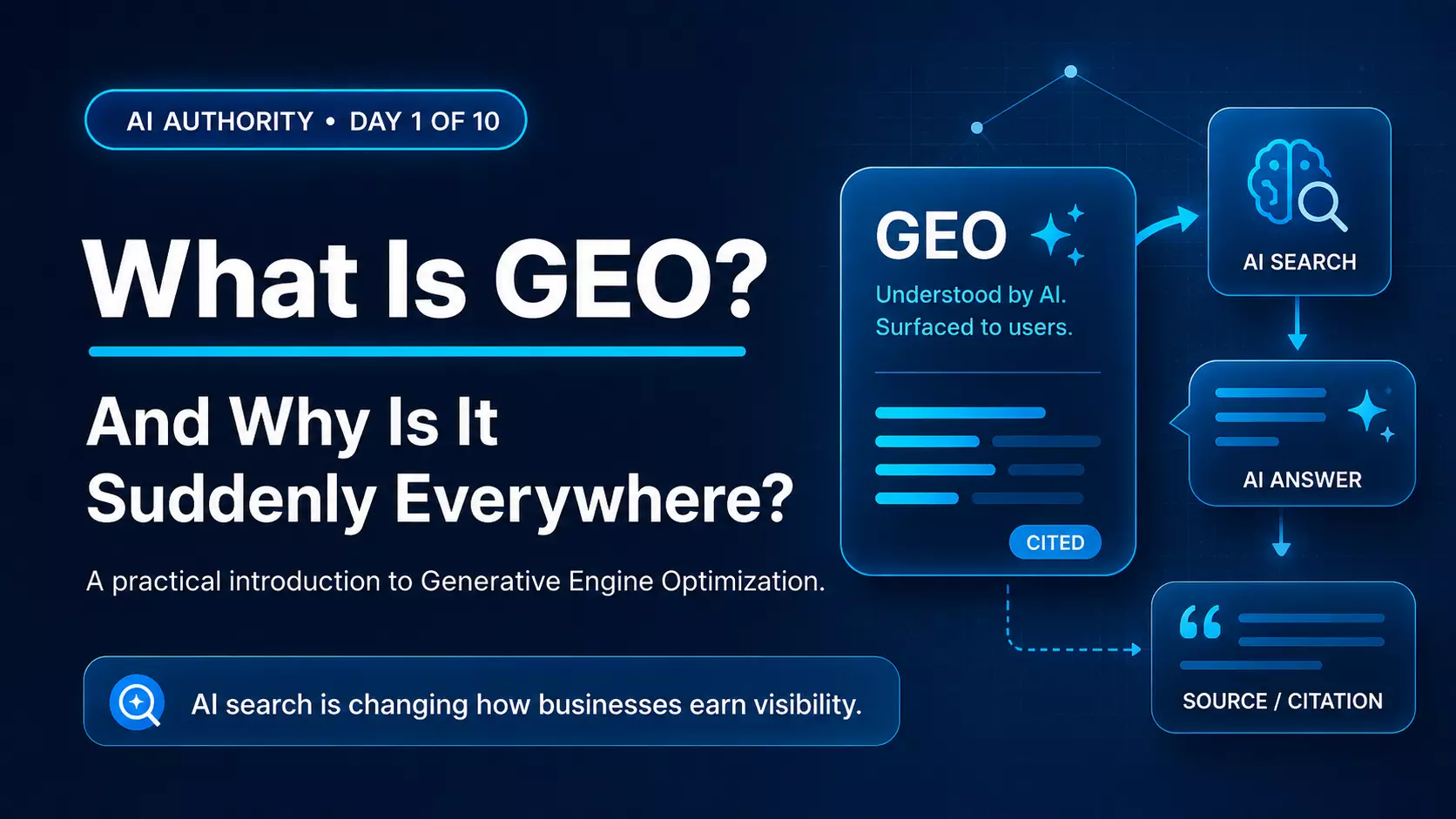
Welcome to AI Authority. Over the next ten days I will walk you through how AI assistants decide which businesses to mention, and what you can do about it. One short lesson a day, no fluff.
Technical Overview
Generative Engine Optimization (GEO) is the practice of structuring a site’s content, markup, and crawl surface so that large language model retrieval pipelines can fetch, parse, chunk, embed, and cite it. Traditional engines return a ranked list of URLs. Generative engines retrieve candidate passages, synthesize a single answer, and attribute a small number of sources. Optimization therefore targets passage-level retrievability and citation probability rather than position on a results page.
In Plain English
When someone asks ChatGPT, Gemini, Copilot, or Perplexity a question, they do not get ten blue links. They get one answer, with two or three businesses named inside it.
Search used to be about ranking. AI search is about being quoted. Those are different jobs, and they need different preparation.

A quick note on the alphabet soup
You are going to see a lot of acronyms for the same idea. Here is the translation:
The most widely used term. Optimizing for AI systems that generate answers.
Same idea, framed around answering questions directly.
Sometimes used for AI Overview Optimization, meaning Google’s AI answers specifically.
A less common variant of GEO.
Frames the target as the model itself.
Another regional variant.
Marketing shorthand rather than a technical term.
They all describe the same shift. I will use GEO throughout this course because it is the term the industry has settled on.
Does this mean SEO is dead?
Short answer, no. Longer answer in the morning.